
Docent Pipestress & Piping Design & Engineering
Docent Pipestress & Piping Design & Engineering
Pipe stress is a specialised discipline, but a sound basic understanding already makes a real difference in practice. With Pipe Stress 1: Thermal Expansion, Flexibility and Supports, you build a solid foundation for understanding the behaviour of piping systems. This training course covers the basic principles of pipe stress and helps you account for stresses, displacements and supports at an early design stage. This helps prevent issues later in the project and enables you to work more effectively with specialists.
Course type
Technical Modules
Teaching location
Rotterdam
Course days
4 avonden
Start date
01-09-2027
The training Pipe Stress 1: Expansion, Flexibility & Piping Supports covers the fundamentals of pipe stress in industrial piping systems. Across four sessions, participants learn how stresses, forces, moments and deformations occur as a result of temperature changes, internal pressure, dead weight, pipe supports and displacements of connected equipment.
The training starts with the principles of flexibility analysis: which data is required, how to assess the configuration of a piping system and which loads need to be considered. The programme then covers thermal expansion, anchor forces, DLT formulas, the L-bend nomogram, the Kellogg formula, pipe supports, spring hangers, expansion joints and wall thickness calculations.
The focus is on technical understanding and practical assessment. Participants do not only learn how to perform calculations, but also why pipe stress occurs and which design choices affect the reliability of a piping system. With this knowledge, they are better able to assess piping routes, support concepts and design assumptions, and to work more effectively with piping engineers, stress engineers, mechanical engineers and project teams.
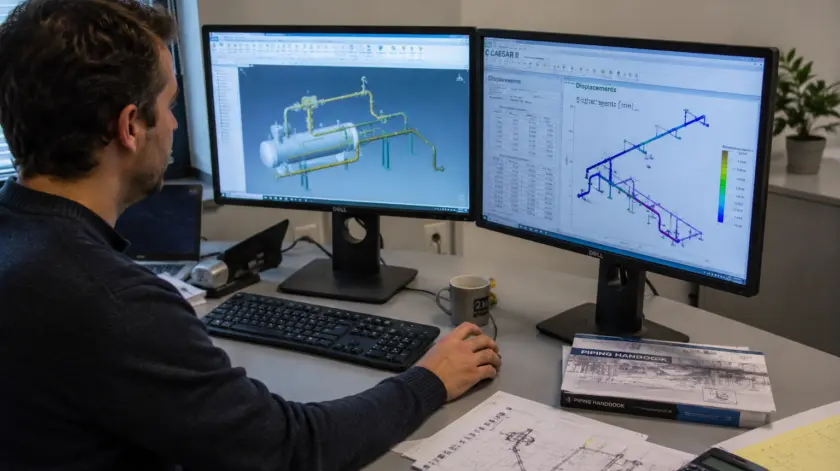
Pipe Stress 1 is intended for piping designers and engineers who want to deepen their basic knowledge. The training is a logical next step for professionals with several years of experience and forms a strong follow up to the Piping Design & Engineering programme. Start with a short refresher course and build towards a higher level of insight and application.
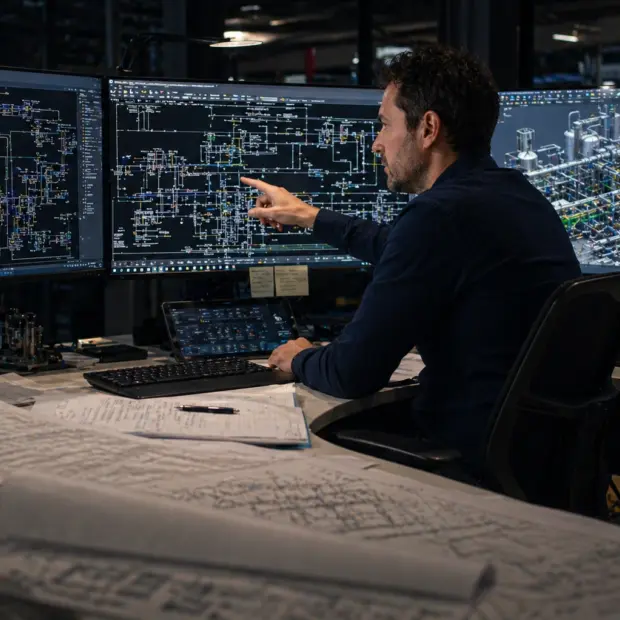
The Pipe Stress 1 training course consists of 4 evening sessions from 17:30 to 22:00. A hot evening meal, study materials and a certificate of participation are included.
The fee is €1,207 per person, excluding VAT.
Current and former participants of our Piping Design & Engineering programme can take part at a reduced rate.
Fee: €1,207 excluding VAT
Duration: 4 evenings
Pipe Stress 1 as part of the pipe stress training track
Pipe Stress 1 forms the foundation of the full pipe stress training track. Pipe Stress 2 and Pipe Stress 3 build further on calculations according to standards and on pressure bearing components. By following multiple modules, you gradually expand your knowledge and understanding of pipe stress.
After successfully completing Pipe Stress 1, 2 and 3, you receive the Pipe Stress diploma. A combination rate applies when registering for all three modules.

Docent Pipestress & Piping Design & Engineering

Daniel van der Ham | 19-04-2027
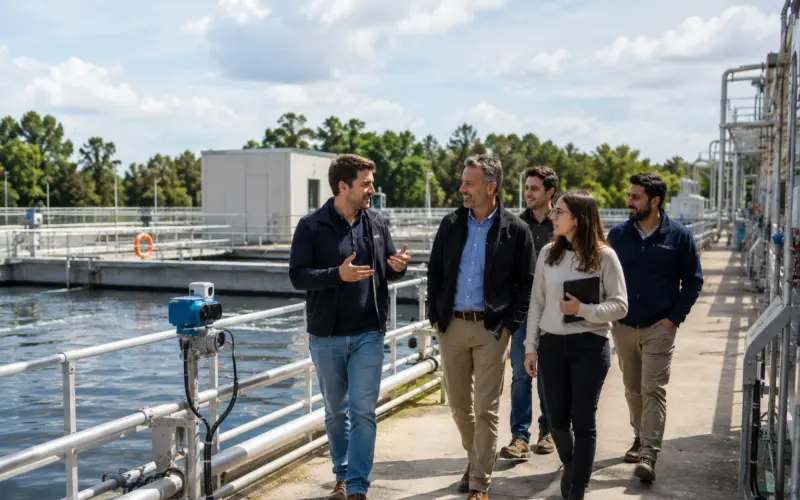
Do you want to learn how to lead a construction team with a sharp focus on safety, quality, budget and planning? Dosign Academy’s Construction Management programme prepares you for a responsible role in both modification and new build projects in the process industry.
You learn not only how to organise projects efficiently, but also how to safeguard safety, manage risks and lead people. With this programme, you build a strong foundation for a career as a construction manager within complex technical projects.

Sven van den Hil | 17-09-2027
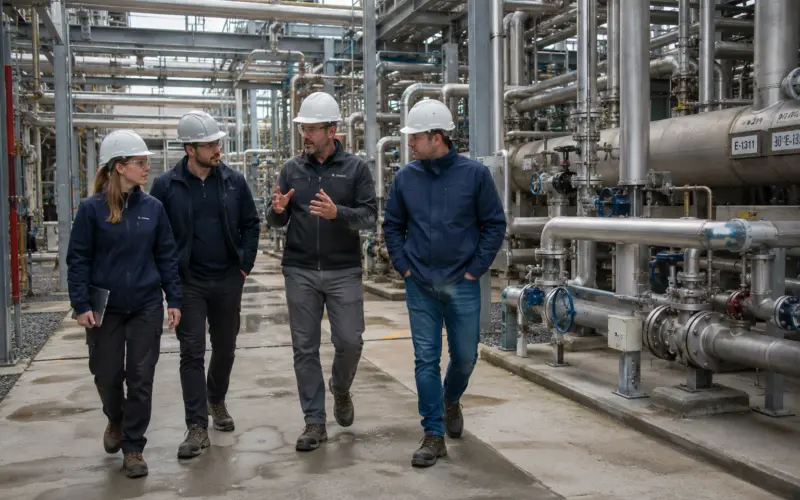
Do you want to deepen your knowledge of instrumentation engineering and play a key role in optimising industrial processes? With Dosign Academy’s Instrumentation Engineering programme, you learn how to design, implement and maintain instrumentation and control systems within the process industry.
This programme combines theoretical knowledge with practical application, giving you the knowledge and skills needed to work as an instrumentation engineer.

Wil Maassen | 14-09-2027
Do you have a mechanical background and a strong sense of creativity and spatial insight? Do you want to learn the discipline of piping design and engineering and work on complex piping systems within the petrochemical, chemical or oil and gas sector? Then Dosign Academy’s Piping Design & Engineering programme is the right step for your career. This practical programme gives you a solid foundation to start working as a piping engineer and introduces you to all key aspects of the discipline.
Pipe stress requires technical insight and a strong feel for practical application. At Dosign Academy, we combine theory with recognisable practical situations, so you understand how pipe stress issues occur in real projects. Pipe Stress 1 was developed to give engineers and designers a shared foundation and to improve collaboration within projects.
Personal advice and guidance
We help you determine whether Pipe Stress 1 fits your experience and role. This way, you follow a training course that matches your current knowledge level and develop insight that can be applied directly.
Experienced trainers from industry
Our trainers have extensive experience with piping engineering and piping systems. They share practical examples and key points of attention, so you learn how pipe stress can be taken into account from the design stage.
Practice based pipe stress training
The focus is on insight and applicability. You do not learn to calculate for the sake of calculation, but to understand why certain design and support choices matter.
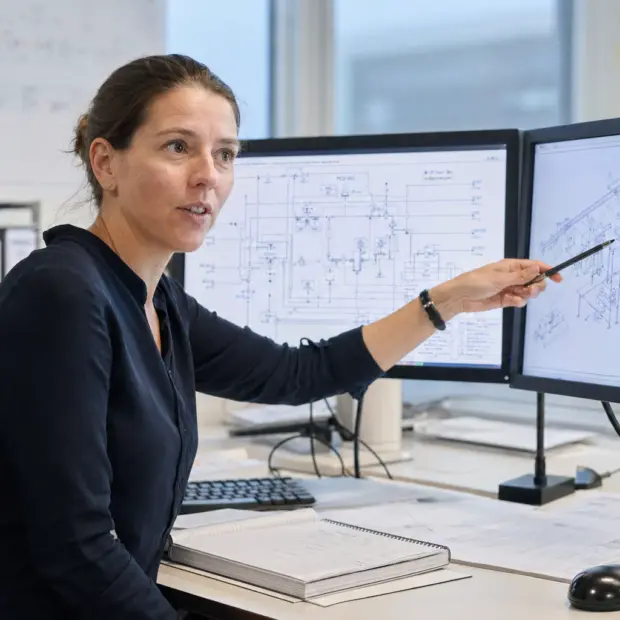
Thermal expansion, flexibility and pipe supports largely determine how a piping system behaves. Insufficient attention to these aspects can lead to excessive stresses, unwanted forces and additional correction rounds during later project phases. With Pipe Stress 1, you develop the insight to recognise these effects early and include them in the design of piping systems.
Do you want to build a solid foundation in pipe stress and account for stresses and supports during design? Choose Pipe Stress 1: Thermal Expansion, Flexibility and Supports at Dosign Academy and develop insight that directly contributes to more efficient and better substantiated designs.